For years, the dominant story of Philippine e-commerce was simple: millions of shoppers logging onto Shopee and Lazada to buy everything from electronics to household goods. But a shift is reshaping digital commerce across the archipelago. Filipinos, especially those living outside Metro Manila, are no longer just searching for products to buy; they are searching for ways to accept payments for products they sell.
Moving Past the Marketplace Duo
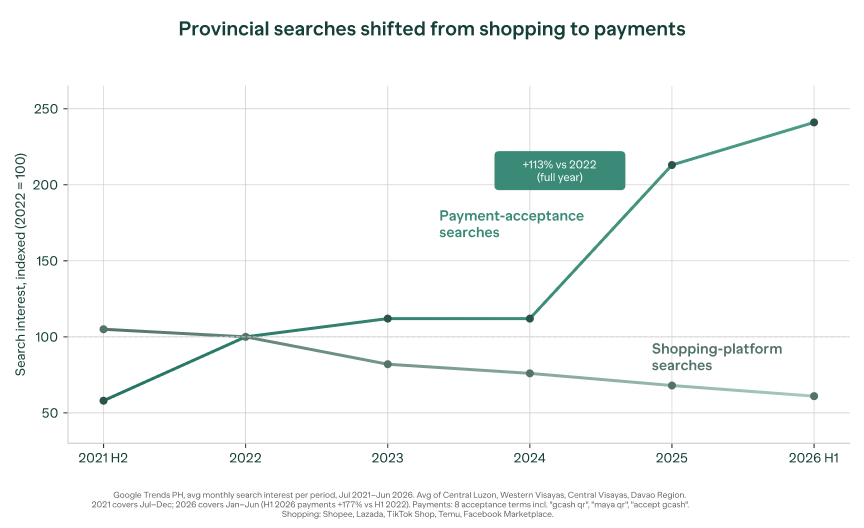
Search interest for major shopping platforms dropped 37% between mid-2022 and mid-2026. Rather than a sign that online shopping is fading, it could be the end of an era ruled exclusively by two marketplace giants.
Filipino consumers and micro-entrepreneurs are moving into a far more fragmented landscape. Instead of relying solely on marketplace algorithms, a growing cohort of merchants is running stores through social media channels, personal websites, and physical pop-ups. To make that direct-to-consumer setup work, accepting digital payments directly has become essential.
A Provincial Merchant Boom
This shift toward merchant adoption is exploding faster in the provinces.
Search interest for accepting digital payments, including terms like “accept gcash,” “accept maya,” and “accept qrph”, nearly tripled across provincial regions between 2022 and the first half of 2026, according to an analysis of Google Trends data released by fintech firm PayMongo.
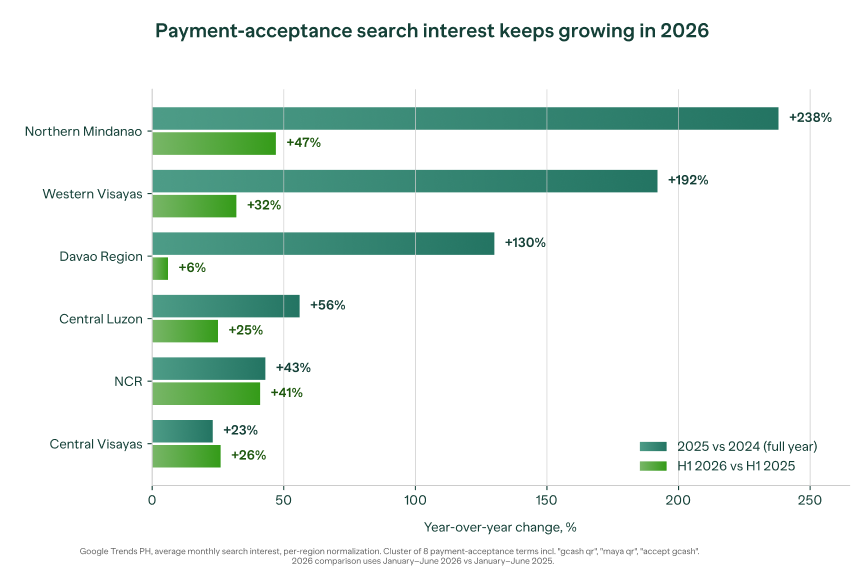
Growth accelerated sharply over the past year. Payment-acceptance searches rose 238% year-over-year in Northern Mindanao, 192% in Western Visayas, and 130% in the Davao Region in 2025, vastly outpacing Metro Manila’s 43% growth.
Data from PayMongo’s own merchant network reflects this ground-level expansion:
- Completed transactions grew 89% from H1 2025 to H1 2026.
- Active merchant base nearly doubled, growing 93% over the same period.
- Platform seller tools (such as “seller center” searches in Davao) spiked alongside digital payment queries, confirming that provincial Filipinos are actively opening shop rather than just browsing.
Challenger Platforms and Interoperability
As shoppers and sellers branch out, alternative platforms are benefiting. Challenger options like TikTok Shop, Temu, and Facebook Marketplace grew their share of shopping searches from 2% in 2022 to between 8% and 13% by 2026, with regions like Eastern Visayas, Central Visayas, and Davao leading adoption ahead of Metro Manila.
At the same time, payment habits are diversifying. Search interest for “maya qr,” which was negligible before 2024, has since multiplied across Central Luzon, Central Visayas, and Metro Manila. This trend aligns with the Bangko Sentral ng Pilipinas’ (BSP) QR Ph interoperability agenda, which indicates that both consumers and sellers are embracing multi-provider QR payments as a standard habit.
Even Metro Manila is seeing early signals of a new entrepreneurial cycle: searches for “online business ideas” and “how to sell online” jumped 59% in the first half of 2026 compared to the previous year.
The nationwide shift toward independent digital selling is only beginning.
This article is published on BitPinas: Filipinos Are Searching Less for Shopee and Lazada—Because They’re Becoming the Sellers, Says Paymongo
What else is happening in Crypto Philippines and beyond?