The White House has reportedly planned an Aug. 19 meeting with crypto and prediction market executives as Polymarket traders place the CLARITY Act’s 2026 passage odds at 21%.
Summary
- Crypto and prediction market executives are expected to meet at the White House on Aug. 19.
- President Donald Trump’s attendance and the full participant list remain unclear.
- Polymarket traders give the CLARITY Act a 21% chance of becoming law in 2026.
- The CFTC will discuss crypto and prediction markets at its inaugural IAC meeting on Aug. 20.
White House meeting may address unresolved crypto disputes
Politico reported on Aug. 13 that the White House is expected to host executives from the crypto and prediction market sectors on Aug. 19, citing people familiar with the planned gathering.
According to the report, the White House has not disclosed a formal agenda or released a list of participants. Executives from traditional financial companies may also attend, while it remains unclear whether President Donald Trump will take part.
The scheduled gathering would place administration officials and industry leaders in the same room while the Senate remains away for its August recess. Crypto companies have continued pressing lawmakers to pass the Digital Asset Market CLARITY Act, which would establish federal rules for digital assets and divide oversight between the Commodity Futures Trading Commission and the Securities and Exchange Commission.
For U.S. investors and crypto companies, the legislation would determine which regulator oversees different types of tokens, exchanges, brokers, and dealers. The bill would place digital commodity spot markets under the CFTC while leaving assets classified as securities within the SEC’s jurisdiction.
The House passed its version of the bill by a 294-134 vote in July 2025, with 78 Democrats supporting the measure. The Senate Banking Committee later advanced its version by a 15-9 vote in May 2026, but the proposal has not received a floor vote.
Senate Majority Leader John Thune said before the recess that lawmakers did not have enough time to complete debate and amendments. As crypto.news reported last week, the Senate is scheduled to return on Sept. 14, leaving a limited period before government funding negotiations and the midterm election calendar consume floor time.
CLARITY Act still faces ethics and stablecoin disagreements
Negotiations have remained stuck on provisions covering government ethics, stablecoin rewards, decentralized finance, and financial crime controls. Each dispute could affect whether Senate leaders can secure the bipartisan support needed to advance the bill.
Under Senate rules, supporters need 60 votes to overcome a filibuster and begin final consideration. Republicans hold 53 seats, meaning the proposal requires several Democratic votes even if nearly every Republican backs it.
One unresolved issue concerns restrictions on crypto holdings and income involving senior government officials. Politico reported that the Senate is waiting for a bipartisan ethics package developed by Republican Sen. Thom Tillis and Democratic Sen. Ruben Gallego.
The White House had not approved the proposed package before senators left Washington, according to the supplied report. Negotiators have discussed ethics rules as Democrats seek tighter controls on crypto activity involving the president, vice president, lawmakers, and other senior officials.
Stablecoin rewards have created another division between crypto companies and U.S. banking organizations. Banks argue that rewards tied to stablecoin balances could pull deposits away from traditional lenders, while crypto companies want platforms to retain the ability to offer certain activity-based incentives.
In July, banking groups urged Thune and Senate Minority Leader Chuck Schumer to revise Section 404 of the bill. The American Bankers Association, Independent Community Bankers of America, and 76 state banking associations said the existing language did not clearly prevent incentives that operate like bank interest.
The associations said community banks use deposits to fund mortgages, agricultural credit and small-business loans. Their letter asked senators to remove provisions allowing rewards based on factors such as account activity or the length of time a customer holds a stablecoin.
Current draft language bars interest or yield on idle payment stablecoin balances but allows rewards connected to certain transactions or activities. Crypto representatives and banking groups disagree over whether the exception preserves customer rewards or creates a route around the prohibition.
Prediction markets price a low chance of passage
Polymarket traders assigned the CLARITY Act a 21% chance of becoming law in 2026 on Aug. 14, according to the platform’s live market. The figure had risen from 17% a day earlier following reports of the White House meeting.
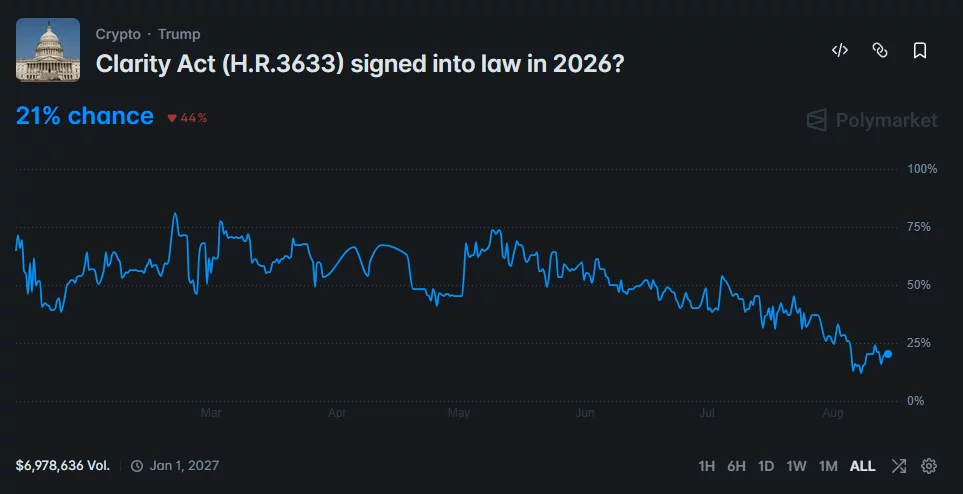
The contract has attracted about $7 million in trading volume, according to Polymarket’s market page. Its rules require H.R. 3633 to be enacted before Jan. 1, 2027, for “Yes” positions to resolve successfully.
Prediction market prices represent traders’ implied probability rather than an official forecast. The contract fell sharply after the Senate confirmed it would leave for recess without voting, dropping from a February peak of 82% to 16% by early August.
A White House meeting does not itself change the bill’s procedural status. Any agreement on ethics, stablecoin rewards, or other disputed language would still need support from Senate negotiators and enough lawmakers to clear the 60-vote cloture threshold.
Even if the Senate approves an amended measure, Congress would have more work to complete. The House would need to accept the Senate text, or both chambers would have to reconcile their differences before sending a final bill to Trump for his signature.
CFTC meeting will follow one day later
The White House event is expected one day before the CFTC holds the inaugural meeting of its Innovation Advisory Committee in Washington.
According to the CFTC’s Aug. 13 agenda, committee members will discuss the regulation of crypto assets, artificial intelligence, and prediction markets. The three-hour meeting is scheduled for Aug. 20 from 1 p.m. to 4 p.m. Eastern time.
An Aug. 13 report on the IAC noted that committee members will attend in person while the public can watch online. The CFTC did not identify a proposed rule that members will vote on or state that the session will produce an immediate policy change.
The advisory committee can provide recommendations to the commission but cannot independently issue or enforce regulations. CFTC Chair Michael Selig sponsors the panel, which includes entrepreneurs, researchers, financial industry participants, and other specialists.
Congress is considering giving the CFTC authority over spot markets for digital commodities through the CLARITY Act. Existing law already gives the agency oversight of commodity derivatives, including futures and options tied to assets such as Bitcoin.
Members of the public may submit written statements related to the IAC meeting through Aug. 27. The CFTC said qualifying submissions must identify the Innovation Advisory Committee and will become part of the public record.