
A new OKX report has found that 90% of college students want crypto and blockchain included in financial education, even though only 28% of reviewed U.S. business schools offered related courses.
Summary
- 90% of students and 87% of parents support college-level crypto and blockchain education.
- 33% of students rely mainly on social media for crypto knowledge, compared with 7% who cite schools.
- 47% of students have taught a parent or guardian about crypto or investing.
- 56% of students would accept 20% of their salary in Bitcoin.
Crypto education demand exceeds course availability
In its New Money Curriculum report shared with crypto.news on Aug. 26, OKX said support for crypto education extended across both generations surveyed, with 87% of parents joining 90% of students in saying colleges should teach crypto and blockchain.
Some respondents wanted more than an optional course. According to the report, 27% of students and 32% of parents said crypto and blockchain education should be required for college students.
Formal course availability remained far below those figures. A separate 2025 study published in the Information Systems Education Journal examined 533 U.S. universities with business schools accredited by the Association to Advance Collegiate Schools of Business.
Researchers searched university websites and course catalogs in March 2024 and found that 151 institutions, or approximately 28%, offered at least one blockchain-related course. The study counted courses across business, computer science, engineering, and other departments rather than limiting its review to standalone blockchain programs.
Course depth also varied between institutions. While 151 schools offered at least one relevant class, only 76 had two or more, and two universities offered at least 10. The most common subjects included blockchain fundamentals, smart contract development, and cryptocurrency economics.
The contrast combines two separate datasets: OKX measured support among students and parents, while the academic review measured course availability at AACSB-accredited U.S. business schools. The published OKX report did not disclose the number of survey respondents, the fieldwork dates, or the method used to select participants.
Some crypto companies have started funding university programs directly. As previously covered by crypto.news, Ripple signed a five-year Kansas partnership in July that included financial literacy and digital-asset education for University of Kansas student-athletes and other members of the campus community.
The University of Kansas also operates an XRP Ledger validator through its engineering school, supported by Ripple’s University Blockchain Research Initiative. Although the arrangement adds practical blockchain exposure, it represents an industry-backed program rather than evidence of a system-wide increase in college courses.
Social media has become students’ main crypto teacher
With formal classes available at a minority of the universities reviewed, students named social media and influencers as their leading source of crypto information.
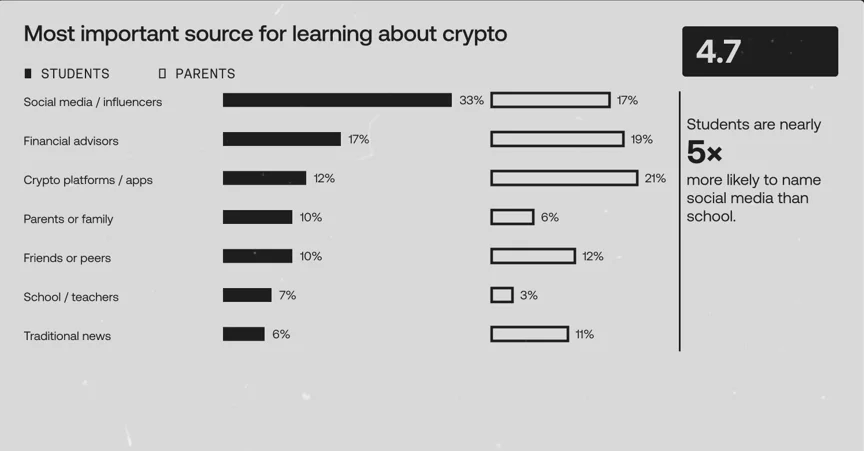
OKX reported that 33% of students considered social media or influencers their most important source, nearly five times the 7% who selected schools, teachers, or professors. Financial advisers ranked second at 17%, followed by crypto platforms and apps at 12%.
Family and friends each accounted for 10% of students’ main source of information, while traditional news ranked last at 6%. The results place most student learning outside college classrooms and professional media, based on the categories included in the survey.
Parents followed a different pattern. Crypto platforms and apps ranked first among that group at 21%, followed by financial advisers at 19% and social media or influencers at 17%. Friends or peers accounted for 12%, while 11% selected traditional news.
Students were therefore almost twice as likely as parents to depend primarily on social media for crypto information. OKX said exchanges also played a material educational role because platforms and apps ranked first among parents and third among students.
The survey did not test whether respondents understood specific subjects such as wallet security, private-key management, token valuation, taxes, or fraud. Its findings measure where participants said they learned and how they viewed their knowledge, rather than independently assessing their financial literacy.
Separate university initiatives show how some programs combine classroom teaching with applied work. In August, Ripple renewed its support for NYU Abu Dhabi’s blockchain research program through 2027.
The funding supports a hands-on fintech course, student projects built with the XRP Ledger, and research into blockchain-based economic tools. Ripple said its university program has supported more than 800 new or expanded fintech courses and 1,500 academic blockchain research projects across more than 60 university partners in 27 countries.
Students are teaching parents about crypto
Although students often learned outside college, many carried the information back into their households. 47% said they had taught a parent or guardian something about crypto or investing, while 43% of parents said their college-aged child had taught them about either subject.
About one-quarter of students said their lessons specifically covered crypto, either by itself or alongside other investing topics. Perceptions of knowledge followed the same pattern: 53% of students said college students understood crypto better than their parents, and 51% of parents agreed.
Only 14% of students and 13% of parents believed parents held the knowledge advantage. Parents also showed some willingness to rely on their children, with 56% saying they would definitely or probably allow a college-aged child to make a crypto transaction for them.
Reported activity remained much lower than stated trust. Just 9% of students said they had completed a crypto transaction for a parent.
Investment authority produced less agreement. Among students, 36% said they should have the most influence over their first investment decisions, compared with 16% who selected their parents. Parents divided almost evenly: 29% said the student should lead, while 30% assigned the main role to parents or family.
Both groups also tended to view crypto as an investment instead of entertainment. 52% of students described buying crypto as a long-term investment, nearly nine times the 6% who called it a hobby. Among parents, 48% chose long-term investment, and 9% selected a hobby.
Allocation preferences were more restrained than the acceptance figures alone suggest. While 89% of students said some crypto exposure could form part of a responsible portfolio, 11% said the appropriate allocation was zero. The report did not provide the full breakdown of allocation sizes in its published text.
Bitcoin salary interest brings U.S. tax obligations
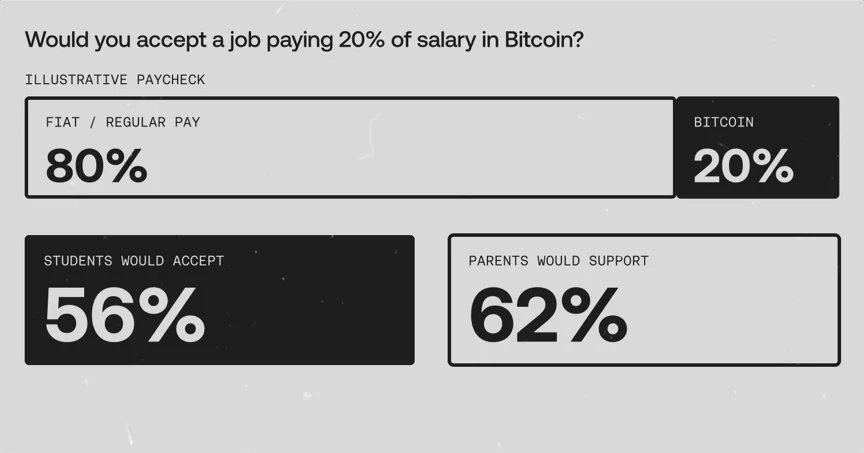
Interest in digital assets extended from portfolios to employment, with 56% of students saying they would definitely or probably accept a job that paid 20% of their salary in Bitcoin. Parent support was higher at 62%.
For U.S. workers, receiving Bitcoin as wages would not remove the usual federal tax obligations. The IRS Taxpayer Advocate Service states that digital assets received as compensation are treated as ordinary income, while an employee’s crypto wages remain subject to federal income-tax withholding, Social Security, Medicare, and unemployment taxes.
After receipt, the employee generally holds the Bitcoin as a capital asset. A later sale or exchange may create a capital gain or loss based on the difference between its value when received and its value when disposed of, according to the IRS.
Operational and tax questions have already complicated crypto payroll adoption. A September 2025 crypto payroll analysis cited a Pantera Capital compensation survey showing that the share of crypto-sector workers receiving digital assets rose to 9.6% in 2024.
Despite students’ interest in Bitcoin pay, both generations still placed real estate first when asked which asset college students might regret not owning. Real estate led among 27% of students, followed by AI and technology stocks at 23%, the S&P 500 at 20%, and Bitcoin at 17%.
Parents produced a similar result at the top but ranked Bitcoin more highly. Real estate received 26% of parent responses, while Bitcoin followed at 24%.