Key Takeaways
- On Wednesday, escalating Middle East tensions halted bitcoin’s July rally, dropping its price 3.5%.
- The volatility wiped out $40 billion in bitcoin market cap and triggered $372 million in total crypto liquidations.
- If the Trump administration maintains oil sanctions, high crude prices may push the Fed to hike rates.
Geopolitical Tensions Halt Bitcoin Uptrend
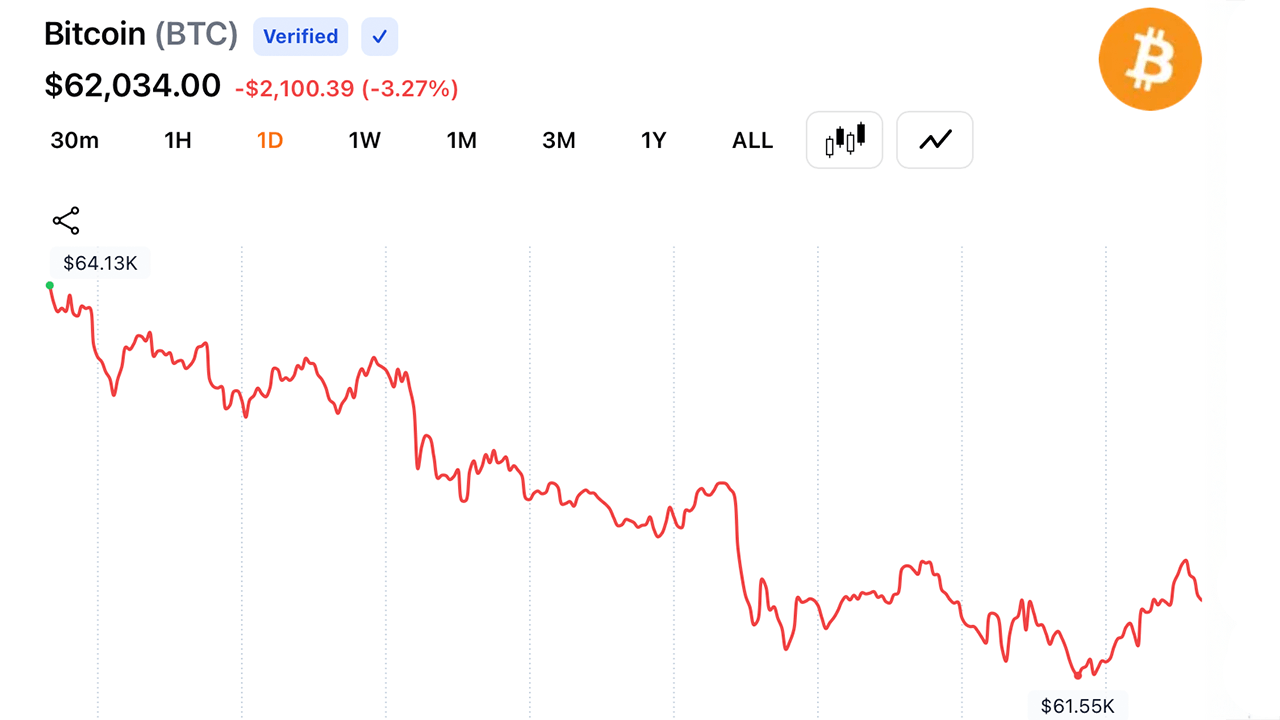
Bitcoin’s July uptrend came to a screeching halt Wednesday, tumbling below $62,000 as escalating Middle East tensions sparked fears that the shaky U.S.-Iran ceasefire had unraveled. Market data shows bitcoin nosedived from a daily peak of just over $64,100 to a low of $61,481 by 11:15 a.m.—a swift 3.5% drop in 24 hours.
The sudden reversal erased an impressive week of incremental gains that had pushed the top cryptocurrency up nearly 10% since the start of the month. The cryptocurrency market was rattled not only by active military exchanges but also by the Trump administration’s decision to end sanctions waivers on Iranian crude oil. Remarks from President Donald Trump suggesting that the memorandum of understanding (MOU), between Washington and Tehran was “dead” further soured investor sentiment.
While bitcoin eventually reclaimed the $62,000 level, the pullback dragged its total market capitalization down from a July peak of $1.28 trillion to roughly $1.24 trillion. The volatility triggered a massive liquidation wave, with more than $65 million in long bets wiped out, compared to just $13 million in shorts. Total crypto market liquidations topped $372 million, with long positions accounting for $310 million of the damage.
Global Markets React
Although U.S. benchmarks like the Nasdaq and S&P 500 managed to tread water and close mostly flat, the escalating tit-for-tat military exchanges sent shockwaves through broader global equities. Asia bore the brunt of the risk-off sentiment, with South Korea’s tech-heavy Kospi index leading a steep regional retreat.
Conversely, the bellicose rhetoric by the two protagonists acted as a catalyst for energy markets. The global benchmark Brent crude surged on the news, aggressively breaching the critical $80-per-barrel threshold for the first time since June 19.
While the U.S. sanctions waiver had allowed Iran to move millions of barrels off Kharg Island, reports indicate the bulk of that supply has yet to be delivered. Ending the waiver severely complicates Iran’s ability to generate oil revenue, raising the risk that Iranian forces or their allies might retaliate by disrupting crucial shipping chokepoints like the Strait of Hormuz and the Bandar Abbas shipping lanes.
Simultaneous disruptions in both lanes would deal a devastating blow to a global oil market already reeling from ongoing conflict in the Middle East. Higher crude oil prices raise the prospect of the Federal Reserve hiking interest rates, which in turn dampens the bull case for bitcoin. However, if the Trump administration quickly walks back some of the statements made by the U.S. President, oil prices will likely decline and return bitcoin to where it was before the latest escalation.