NEAR Protocol price has fallen nearly 7% to $3.74 on November 6 as heavy cryptocurrency liquidations and losses across US technology stocks have pushed the token toward critical support levels.
Summary
- NEAR Protocol price fell 7% to $3.74 as cryptocurrency liquidations exceeded $1 billion across markets.
- NEAR’s approved issuance reduction proposal has failed to prevent further losses amid widespread cryptocurrency selling pressure.
- Analyst Ali Martinez identified a TD Sequential buy signal, targeting potential recoveries toward $4.30 and $4.80.
- NEAR faces immediate support around $3.60, with a breakdown potentially exposing lower levels near $3.20.
- Technical indicators remain bearish despite analysts identifying possible accumulation opportunities following NEAR’s recent price correction.
According to crypto.news market data, NEAR traded between $3.63 and $4.05 over the past 24 hours, with trading volume reaching $671.98 million. The token has lost 12% over seven days and 28% over the past month, leaving its market capitalization near $4.9 billion.
The latest decline follows a difficult period for the cryptocurrency market, although several analysts have begun identifying possible buying opportunities. Technical indicators still favor sellers, but NEAR’s approach toward $3.60 has drawn attention from traders watching for a potential reversal.
NEAR Protocol price falls as crypto liquidations exceed $1 billion
NEAR’s decline has followed heavy selling across cryptocurrencies after US technology stocks suffered substantial losses on November 5. The Nasdaq Composite fell 5.5%, while the S&P 500 lost 4.3%, as concerns about artificial intelligence spending and political uncertainty weighed on investor sentiment.
Bitcoin dropped more than 6% toward $75,000 during the same period, while leveraged traders faced widespread liquidations. As crypto.news previously reported, more than $1 billion in leveraged cryptocurrency positions were liquidated as falling prices forced traders to close their positions.
Long positions accounted for most of those losses, adding selling pressure to an already weak market. NEAR followed the decline but recorded heavier losses than the overall cryptocurrency market, which fell nearly 5%.
The token had already been struggling before Friday’s decline. On November 3, NEAR fell below $4, losing nearly 9% as selling affected several AI-related cryptocurrencies.
Despite the recent weakness, NEAR remains up 95.91% over the past year. Its current price is considerably below the October peak near $6, which has become an important reference point for analysts assessing the correction.
NEAR supply reduction vote fails to support price recovery
NEAR’s decline has continued despite the network’s approval of a proposal to reduce annual token issuance.
Under proposal HSP-029, which passed its House of Stake vote on November 2, the network plans to lower maximum annual issuance from 2.5% to 1.6% over 24 months.
The proposal received almost 99.9% support and projects that the revised schedule would prevent roughly 11.8 million additional NEAR tokens from entering circulation over two years compared with the existing arrangement.
However, the reduction has not taken effect. The proposal still requires Security Council review, a grace period and validator adoption before the network can implement the changes.
Lower issuance would reduce token dilution, although staking rewards would decline under the proposed arrangement. The approval has therefore failed to generate an immediate price recovery, with traders continuing to sell amid market uncertainty.
The price reaction has raised the possibility of “sell-the-news” trading, where investors reduce their positions following an anticipated announcement. However, the available trading data does not establish that the governance vote caused NEAR’s decline.
NEAR Protocol price analysis shows a possible buy signal
Crypto analyst Ali Martinez, known as Ali Charts, has identified a TD Sequential buy signal on NEAR’s daily chart, suggesting that the prolonged correction could be approaching a turning point.
Martinez noted that the indicator previously flashed a Sequential Aggressive 13 signal on October 12, before NEAR declined 39.57% from almost $6 to $3.63.
The latest signal points toward a possible recovery, with Martinez watching $4.30 as the first upside target and nearly $4.80 as the next resistance level.
Meanwhile, analyst Michaël van de Poppe described NEAR’s current trading range as increasingly attractive for accumulation, although he prefers prices below $3.50 for potential entries.
Another analyst, Giannis Andreou, identified $3.60–$3.80 as the area buyers must defend before a sustainable recovery can develop.
According to Andreou, a daily close above $4.10–$4.30 could open the way toward $4.80–$5.00. Further gains would bring the previous resistance around $5.50–$6.00 into focus, while the upper rising trendline approaches $7 depending on when prices reach it.
NEAR Protocol price prediction: Can $3.60 support hold?
NEAR remains under bearish pressure on the daily chart, having formed a series of lower highs and lower lows since its October peak.
The Moving Average Convergence Divergence indicator remains negative, with the MACD line at -0.241 below the signal line at -0.130. Its histogram stands at -0.110, indicating that selling momentum continues.
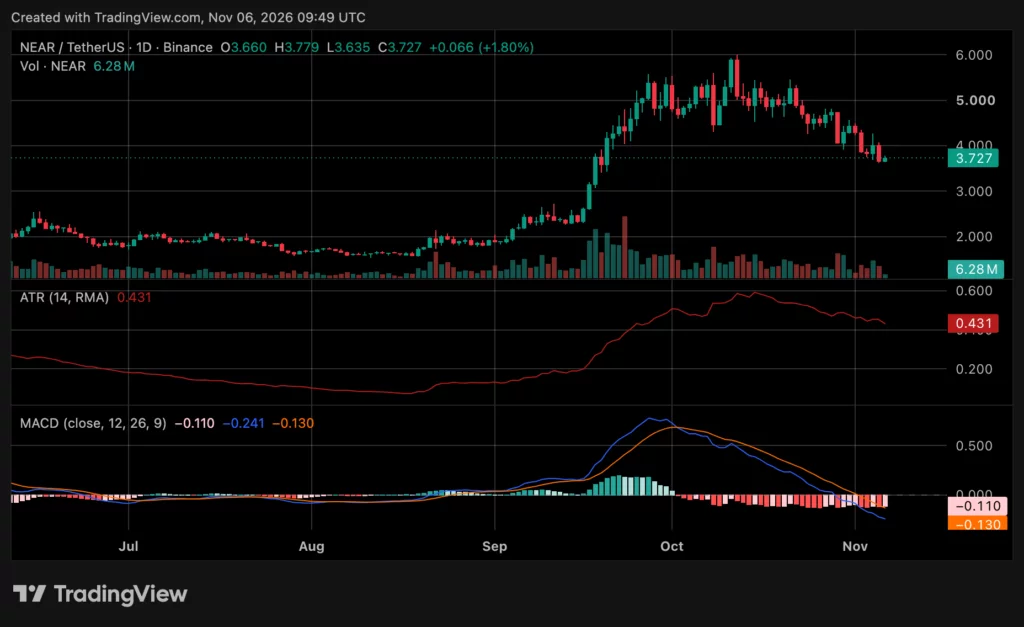
The Average True Range stands at 0.431, showing that price volatility remains elevated despite easing from October’s higher readings.
Immediate support sits between $3.60 and $3.73. A sustained recovery above $4.00 could bring $4.30 and subsequently $4.50 into focus, while a stronger breakout could support the higher targets identified by Martinez.
However, Andreou warned that a daily close below $3.60 would weaken the current support area and expose $3.20–$3.30, followed by $2.80–$3.00.
Van de Poppe’s preferred accumulation area below $3.50 sits between those downside levels, providing another price range traders are monitoring as the correction continues.
Disclosure: This article does not represent investment advice. The content and materials featured on this page are for educational purposes only.