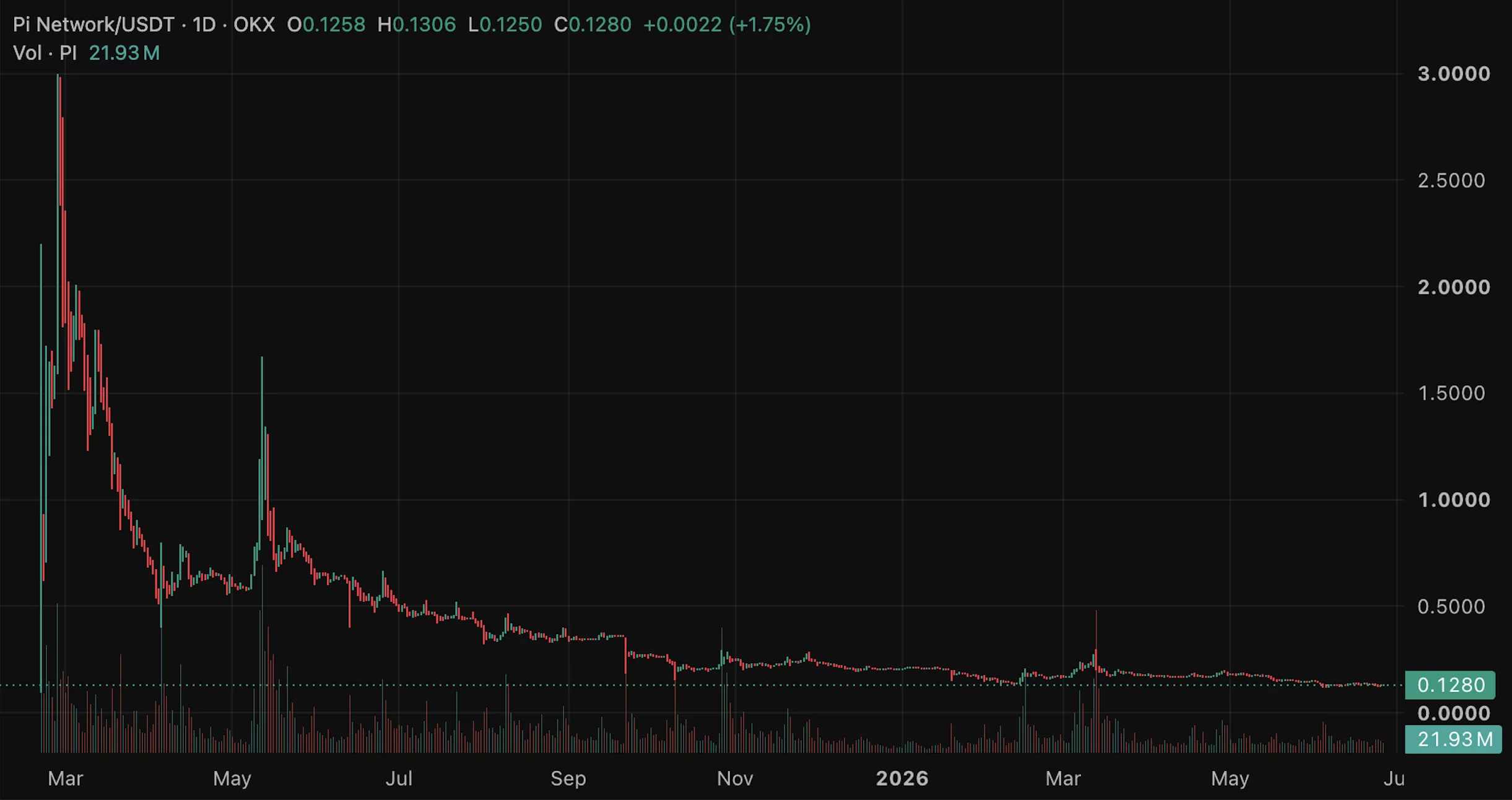
Pi trades near $0.12, sitting on its all-time low, down roughly 95% from its peak. Getting back to $0.20 would take a 60% gain. This guide weighs the unlocks and thin liquidity dragging it down against the upgrades and the Pi2Day catalyst that bulls are counting on.
Summary
- Pi trades near $0.12-$0.13, sitting on or just below its all-time low near $0.13, down roughly 95% from its post-listing peak above $2.90.
- Reclaiming $0.20 would require a gain of roughly 60% from current levels, a large move against a year-long downtrend, and persistent selling pressure.
- The core drag is supply meeting weak demand: ongoing token unlocks add millions of coins while 24-hour volume sits below $10 to 26 million against a market cap over $1.3 billion, a sign of thin liquidity.
- The bull case rests on catalysts: the annual Pi2Day event, newly launched smart contracts, a growing app ecosystem, and the long-awaited possibility of a major exchange listing.
- Reclaiming $0.20 before year-end is possible but demanding, requiring real demand to finally outpace the unlocks, with the more likely path a continued grind unless a genuine catalyst lands.
Pi Network’s token trades near $0.12, sitting on or just below its all-time low, and the question for the rest of 2026 is whether it can claw its way back to $0.20, a level that would require a gain of roughly 60% from where it stands now. That framing matters because $0.20 is not an arbitrary target; it is the level Pi traded around as recently as late 2025 before its latest decline, a psychological and technical zone that, if reclaimed, would signal that the relentless downtrend has finally broken.
Getting there, though, means overcoming the forces that have driven Pi down roughly 95% from its post-listing peak above $2 and $0.90: a steady stream of token unlocks that keep adding supply, thin trading liquidity that makes the token fragile, weak real-world utility, and the conspicuous absence of a listing on a major tier-one exchange.
Against those headwinds stand a set of genuine catalysts that Pi’s large community is counting on, including the network’s annual flagship event, the recent arrival of smart contracts, a growing roster of ecosystem apps, and the ever-present possibility of a major listing. This piece weighs the two sides honestly to assess whether a move back to $0.20 is realistic before the year ends.
The reason to frame Pi’s prediction around the twenty-cent question, rather than the wildly divergent multi-year targets that fill most prediction pages, is that Pi’s situation is fundamentally a near-term contest between supply and demand, and $0.20 is the concrete level at which that contest would be visibly resolved in the bulls’ favor.
The wildly optimistic long-term forecasts that some sites publish, and the community calls for prices many multiples higher, are largely disconnected from the mechanics actually driving Pi’s price right now, which are the unlock schedule, the thin liquidity, and the search for real demand.
What follows traces how Pi reached its all-time low, maps the levels that matter, examines the supply problem that defines the token, weighs the catalysts that could spark a recovery against the forces holding it down, and lays out concrete bull, base, and bear scenarios for whether $0.20 is reachable before year-end.
A long way back to $0.20
Start with the distance Pi has to travel, because it frames everything. At roughly $0.20, Pi sits on or just beneath its all-time low near $0.13, having fallen relentlessly from a peak above $2 and $0.90 recorded shortly after its broader market availability. That is a decline of roughly 95%, the kind of drawdown that leaves a token searching for any sign of a floor.
To reclaim $0.20 from $0.12 requires a gain of around 60%, which in the context of crypto is far from impossible over a year, but which represents a major reversal for an asset that has done little but fall and that faces continuous selling pressure from new supply.
The $0.20 level is meaningful precisely because Pi traded around it as recently as the fourth quarter of 2025, before sliding below it and then below subsequent support levels through the first half of 2026, so reclaiming it would mark a genuine break from the established downtrend.
The path to $0.20 was a steady erosion rather than a single collapse. Pi traded in a higher range through much of 2025, with periods in the $0.30-$0.40, before momentum faded in the second half of the year and the price slipped into the twenties and then below.
In early 2026, it broke beneath the twenty-cent area that had served as support, and subsequent attempts to rally, often fueled by ecosystem announcements, failed to hold, with the price repeatedly rejected at higher levels before resuming its decline toward the all-time low.
The token now trades below all of its major moving averages with momentum indicators in or near oversold territory, the technical signature of a sustained downtrend that has not yet found its bottom. The 60% climb back to $0.20, in other words, would have to overcome both the weight of a year-long decline and the specific forces that have driven it, which is why the question is genuinely open rather than a foregone conclusion in either direction.
The levels: $0.097 below, $0.20 above
The technical map around Pi is worth laying out, because it defines how much room there is on each side. Immediately around the current price, support sits in the area of $0.130-$0.135, the zone of the all-time low, with a break below it pointing toward lower levels that some analysts identify near $0.10, and a deeper “ultimate support” flagged around $0.09-$0.10.
These are the downside markers: losing the all-time low would open the door to single-digit-cent territory, a prospect that underscores how fragile the current level is. The fact that Pi is testing its all-time low at all means there is little historical price structure beneath it to provide support, which is part of what makes the downside risk real.
On the upside, the resistance levels are stacked and meaningful, which is what makes the climb to $0.20 demanding. The first hurdle sits near $0.14, with a more significant barrier around $0.16, the level that has recently capped rallies. Above that, the seventeen-to-nineteen-cent zone represents further resistance, and then $0.20 itself, the target, sits at the top of this band as both a psychological round number and a former support-turned-resistance level.
For Pi to reclaim $0.20, it would have to break through this entire stack of resistance in succession, each level representing a point where sellers, including holders looking to exit losing positions and recipients of newly unlocked tokens, are likely to apply pressure.
The structure is therefore asymmetric in a worrying way for bulls: relatively little support beneath the all-time low, and multiple layers of resistance between the current price and the twenty-cent target. Climbing that wall requires sustained buying pressure that has been conspicuously absent, which brings the analysis to the core problem.
The supply problem nobody can ignore
The single most important factor weighing on Pi’s price is the imbalance between supply and demand, and it is worth understanding in detail because it defines the token’s predicament. Pi has a very large maximum supply, and a substantial portion of the total has yet to enter circulation, held back by lock-up mechanisms that release tokens on a schedule. As those unlocks occur, new supply enters the market, and in June alone, the network was set to unlock well over 170 million tokens worth tens of millions of dollars.
This is the crux of the problem: every unlock adds coins that can be sold, and unless demand grows fast enough to absorb them, the additional supply pushes the price down. For a token already in a downtrend, a steady stream of unlocks acts as a persistent headwind, continually replenishing the supply available to sell into any rally.
Compounding the supply pressure is the thinness of Pi’s trading liquidity, which is striking given its size. Despite a market capitalization above $1 billion, Pi’s 24-hour trading volume has at times fallen below $10 million and generally sits in the low tens of millions, an unusually small amount of trading for a token of that nominal value. Thin liquidity makes a token fragile in both directions, but especially on the downside, because relatively small amounts of selling can move the price significantly when there are few buyers, and the steady supply from unlocks meets a market without deep enough demand to absorb it.
This combination, ongoing unlocks adding supply into a thinly traded market with weak organic demand, is the fundamental reason Pi has ground lower, and it is the central obstacle to any recovery toward $0.20. Until demand grows enough to outpace the unlocks and deepen the liquidity, the supply problem will keep exerting downward pressure, which is why the bull case has to rest on catalysts large enough to change the demand side of the equation.
The bull case: catalysts that could spark a move
For Pi to reclaim $0.20, demand has to finally outpace the unlocks, and the bull case rests on a set of catalysts that could, in principle, drive that demand, several of which are concrete and near-term.
The most immediate is the network’s annual flagship event, held in late June, which has historically served as a moment for major ecosystem announcements, including new applications, developer initiatives, and feature launches. Because the community anticipates this event as a catalyst, it can drive a surge of engagement and speculative buying around the date, and a slate of well-received announcements could refresh the narrative around Pi and spark the kind of demand the price needs.
The event functions as a recurring opportunity for a positive surprise, and with it falling just days away from the current moment, it is the most time-sensitive catalyst on the horizon.
The deeper bull case rests on the network’s technical progress and ecosystem growth. Pi recently introduced smart contracts through a series of protocol upgrades, a significant capability that opens the door to decentralized finance, real-world asset tokenization, and more complex applications, potentially giving the token the genuine utility it has lacked.
The ecosystem has shown early signs of life, with new applications and games attracting tens of thousands of users in short periods, developer tools expanding, and initiatives to make it easier for builders to launch apps and reach Pi’s large user base.
If this ecosystem activity translates into real, sustained usage that creates organic demand for the token, it could begin to absorb the unlock supply and shift the supply-demand balance. And hanging over everything is the possibility, long rumored and long awaited, of a listing on a major tier-one exchange, which would dramatically expand access, liquidity, and visibility, and which many in the community view as the single catalyst most capable of driving a substantial repricing.
Each of these, the event, the smart contracts, the ecosystem, and a potential major listing, is a plausible source of the demand a recovery would require, which is what keeps the bull case alive despite the bearish chart.
The bear case: why $0.20 may stay out of reach
Honesty requires giving equal weight to the case that $0.20 stays out of reach, because the bearish argument is grounded in the same structural realities that have driven Pi to its all-time low.
The foundation is the supply problem: the unlocks are scheduled and will continue regardless of sentiment, so unless demand grows substantially and consistently, the steady addition of new supply will keep capping rallies and pressuring the price, making a 60% climb against that headwind genuinely difficult.
The thin liquidity reinforces this, because even if demand picks up, the shallow market can be overwhelmed by unlock-driven selling, and the absence of deep order books makes sustained rallies hard to hold.
The bearish case is reinforced by the demand side’s persistent weakness. Despite a large user base, Pi has struggled to translate that into real economic activity that creates organic token demand, with utility remaining limited and much of the trading driven by speculation instead of usage.
The much-anticipated catalysts have, in the past, repeatedly failed to produce sustained demand: ecosystem announcements have sparked brief rallies that faded, and the major exchange listing that the community counts on has not materialized despite years of anticipation, with no guarantee it ever will.
The risk around the annual event is that announcements fail to meet the community’s high expectations, which could trigger sell pressure instead of a rally. And Pi remains exposed to the broader crypto market, where a weak environment for altcoins provides little tailwind.
The bearish synthesis is that Pi’s problems are structural and have repeatedly defeated the same catalysts the bulls are counting on, so the most likely path is a continued grind near or below the all-time low, with $0.20 remaining out of reach unless something truly changes the demand side in a durable way.
One widely cited analysis has flagged a path toward $0.10 as a real possibility if unlocks keep outrunning demand.
The bull, base, and bear cases for year-end
Tying the scenarios to the supply-demand contest and the catalysts makes them concrete. These are conditional ranges, not predictions, and each depends on whether demand can outpace the unlocks.
- Bull case: a genuine catalyst lands, whether a strong slate of announcements at the annual event, real adoption of the new smart-contract capabilities, breakout ecosystem usage, or a long-awaited major exchange listing, and demand finally outpaces the unlock supply. Pi breaks through the stack of resistance from fourteen to $0.19 and reclaims $0.20 before year-end, with the upper end of optimistic ranges pointing toward the high $0.20-$0.40 if a major listing in particular materializes.
- Base case: Pi continues to grind in a low range near its all-time low, roughly $0.12-$0.18, as the unlocks and thin liquidity cap rallies while the ecosystem develops too slowly to generate the demand needed for a decisive breakout. In this scenario, the catalysts produce brief rallies that fade, $0.20 is approached at best but not reclaimed durably, and the token ends the year near where it began the second half.
- Bear case: the unlocks continue to outpace weak demand, the anticipated catalysts disappoint, no major listing arrives, and a soft broader market provides no support. Pi loses its all-time low and slides into single-digit-cent territory toward $0.10 or below, with $0.20 firmly out of reach and the structural supply problem dominating.
What to watch
For anyone tracking whether Pi can reclaim $0.20, the analysis points to a clear watchlist, and the first item is the annual event and its immediate aftermath. Because the late-June event is the most time-sensitive catalyst, the substance of its announcements and the market’s reaction will be an early and telling signal: a strong, well-received slate that drives sustained buying would support the bull case, while announcements that disappoint and a rally that fades would reinforce the bearish pattern of catalysts failing to produce lasting demand. Watching how Pi trades around and after the event is the most immediate test.
The second item is the perennial question of a major exchange listing, which remains the single catalyst most capable of a substantial repricing; any credible news of a tier-one listing would be a powerful bullish signal, while continued absence keeps a key source of liquidity and demand off the table.
The third item is the relationship between the unlocks and demand, which is the structural heart of the matter: watching whether trading volume and on-chain usage grow enough to absorb the scheduled unlock supply, or whether the unlocks continue to outpace demand, will indicate which direction the supply-demand balance is tipping. The fourth item is the adoption of the new smart-contract capabilities, and the ecosystem’s growth, since real, sustained usage is what would create the organic demand a durable recovery requires, as opposed to the speculative rallies that have repeatedly faded.
The honest synthesis is that reclaiming $0.20 is possible but demanding, requiring demand to finally and durably outpace the persistent unlock supply, and that, absent a genuine catalyst of sufficient size, the more likely path is a continued grind near the all-time low. The catalysts that could change this are real, and some are near-term, but Pi’s history is a string of catalysts that sparked brief hope and faded, so the burden of proof rests firmly on demand actually showing up this time.
Frequently Asked Questions
Why is Pi trading near its all-time low?
Because of a persistent imbalance between supply and demand. Pi has a very large maximum supply, much of it released gradually through scheduled unlocks, and in some months, well over 100 million tokens enter circulation. That steady new supply meets weak organic demand and unusually thin trading liquidity, with twenty-four-hour volume sometimes below $10 million despite a market cap of over 1 billion. The result is continuous downward pressure: new supply gets sold into a shallow market without enough buyers to absorb it, driving Pi down roughly 95% from its post-listing peak to its current all-time low area near $0.12-$0.13.
What would it take for Pi to reach $0.20?
Demand would have to finally and durably outpace the unlock supply, which requires a genuine catalyst. The most immediate is the network’s annual late-June event, which can drive engagement if its announcements are strong. The deeper drivers would be real adoption of Pi’s new smart-contract capabilities, breakout ecosystem usage that creates organic token demand, and, most powerfully, a listing on a major tier-one exchange, which would expand access and liquidity. Reclaiming $0.20 from $0.12 is a roughly 60% gain, achievable in crypto over a year but demanding against the unlock headwind, so it depends on demand truly showing up.
What is the supply problem with Pi?
Pi has a large maximum supply, and a substantial portion has not yet entered circulation, held back by lock-up mechanisms that release tokens on a schedule. As these unlocks occur, new coins enter the market and can be sold, and unless demand grows fast enough to absorb them, the added supply pushes the price down. For a token already in a downtrend with thin liquidity, this acts as a persistent headwind, continually replenishing the supply available to sell into rallies. The supply problem is the central obstacle to any recovery, because it must be outpaced by demand for the price to rise durably.
Why does Pi’s thin liquidity matter?
Because it makes the token fragile and amplifies the supply problem. Despite a market cap over $1 billion, Pi’s daily trading volume often sits in the low tens of millions or below, unusually small for a token of that size. Thin liquidity means relatively small amounts of selling can move the price significantly when buyers are scarce, so the steady supply from unlocks meets a market without the depth to absorb it smoothly. It also makes rallies hard to sustain, because shallow order books can be overwhelmed. Deepening liquidity, which a major exchange listing would help with, is part of what a durable recovery would require.
Could Pi fall below its all-time low?
Yes, that is the bear scenario, and it is a real risk. Because Pi is testing its all-time low, there is little historical price structure beneath it to provide support, so a decisive break lower could open the door to single-digit-cent territory, with analysts identifying levels near $0.10 and a deeper floor below that. This would happen if the unlocks continue to outpace weak demand, the anticipated catalysts disappoint, no major listing arrives, and the broader market stays soft. One widely cited analysis has flagged a path toward $0.10 as a genuine possibility if supply keeps overwhelming demand.
Are the bullish long-term Pi price predictions realistic?
Most of the very high long-term targets that circulate, including community calls for prices many multiples above current levels, are largely disconnected from the mechanics actually driving Pi’s price, which are the unlock schedule, thin liquidity, and weak demand. Reaching even $1, let alone the far higher figures some promote, would require a combination of full ecosystem adoption, sustained real usage, and much broader exchange access than exists today, and figures in the hundreds or thousands of dollars are not grounded in any realistic near or medium-term scenario. A disciplined view focuses on the near-term supply-demand contest instead of speculative long-range targets.
This article is information, not investment advice. The scenarios described are conditional ranges that depend on unresolved questions, not predictions, and Pi is highly volatile with thin liquidity. Prices, unlock schedules, and ecosystem developments reflect reporting available as of June 26, 2026, and can change quickly. Nothing here is a recommendation to buy or sell. Verify current data from primary sources and consider your own circumstances before making any decision.