I wasn’t prepared for Pressure. Walking into the World War II drama, which stars Andrew Scott and Brendan Fraser, I knew it was about the lead up to D-Day. As such, I braced myself for a serious, stiff-upper-lip drama about soldiers and the cruelty of war. And it’s not that Pressure isn’t about those things. Rather, adapted from David Haig’s 2014 stage play of the same name, Pressure comes from an unexpected angle in exploring war strategy.
Andrew Scott stars as Group Captain James Stagg, a Scottish meteorologist for the United Kingdom’s Royal Air Force, who was assigned to aid American ally General Dwight D. Eisenhower (Brendan Fraser) by figuring out the forecast for the beaches of Normandy for D-Day.
Now, you might be thinking that weather and war don’t sound like rich terrain for laughs. But Pressure‘s humor comes from the crackling cultural conflict between this no-nonsense Scot and the American general in desperate need of a sunny day.
Pressure is as much about social pressure as it is weather and war.

Brendan Fraser and Andrew Scott in “Pressure.”
Credit: Alex Bailey / Focus Features / STUDIOCANAL
Pressure begins with bloodshed in 1944. Before the Allies carried out the biggest seaborne invasion in history (aka D-Day), there was a test run known as Operation Tiger, which failed miserably. Pressure begins in the immediate aftermath of this disastrous exercise, where a boyish young man in uniform stares blankly into the sky, blood washing around his prone body as the tide comes in.
Up and down the beach, there’s a scramble among the survivors to aid whatever soldiers may be saved. Eisenhower looks on, stricken, cursing under his breath. With one brief yet brutal scene, director Anthony Maras, who adapted the screenplay with playwright David Haig, has succinctly established the life-or-death stakes of planning an invasion.
Six weeks later, Eisenhower is in a remote country estate filled with U.S. and UK military, all planning to launch D-Day in 72 hours. The fatal failure of Operation Tiger hangs over him, whether he’s being barked at by a brash British field marshal (Damian Lewis), cajoled by his Irish aide, Kay Summersby (Kerry Condon), or placated by the American’s lead meteorologist, Irving Krick (Chris Messina).
While the energy of these allies ranges from stern to abrasive, patient to bombastic, they’re all pushing for D-Day to launch on Monday morning. Then, on a Friday arrives Stagg, who warns major storms could sink D-Day out the gate.
Introduced in his home in the midst of a cozy morning ritual, Stagg prepares breakfast for his very pregnant wife (Tamsin Topolski), gently assuring her he has time for this bit of intimacy. He is a man of few words, and this will come to frustrate his colleagues as the pressure builds. No sooner does he reach the estate than he’s making curt commands. He points out errors in his men’s work, dismisses the directives of another meteorologist, and is visibly vexed to discover Summersby in his office.
To borrow from reality TV, Stagg is not here to make friends; he’s on mission. Like in Conclave, another excellent Focus Features release, there’s a brilliant humor that erupts when this very serious setting collides with cutting replies to arrogance.
Krick is Stagg’s foil, a suave American who literally performs a lively song and dance (“Boogie Woogie Bugle Boy”) to amuse his troops. Stagg, by contrast, demands the piano be taken away, and literally hits a bad note when slamming its cover closed.
Mashable Top Stories
Where others swoon over Krick’s easy-going attitude, name-dropping stories, and retellings of professional glory, Stagg simply stares, seeming to resent the wasting of time. Later, when arguing against Krick’s proposed forecast of beautiful sunny weather, Stagg flatly calls the man “moronic.” And when Krick complains that Stagg is insulting him to his face, Stagg responds sharply, “I’m not insulting you. I’m describing you.”
In this ruthless honesty, there’s an exciting — and yes, funny — rejection of social norms. And maybe even the thrill of vicariously being so good at your job that you don’t need a charm offensive to be heard.
Pressure is competency porn.

Andrew Scott and Chris Messina in “Pressure.”
Credit: Alex Bailey / Focus Features / STUDIOCANAL
Fun fact: I’m the person who introduced this bit of slang to Pressure‘s leading men. In an interview with Scott and Fraser, I explained how Pressure reminded me of HBO Max’s hit series The Pitt, because both feature people who are so dedicated to their work, and so skilled at it, that it’s deeply — almost orgasmically — satisfying to watch.
While it’s tempting to flatten Eisenhower, Krick, Summersby, and Stagg into symbols to make them broader critiques of American attitudes versus British ones, Pressure bristles against such simplicity. For one thing, Stagg is Scottish, Summersby is Irish, and Eisenhower and Krick are two very different representations of American masculinity. The former is a tall, stern man, haunted by his failures. The other is a dynamic hero, held up by his wins and charm.
Looking at the two of them, it’s tempting to think Krick gives Eisenhower the sunny forecast to please him. But in Messina’s intensity opposite Stagg, it’s easier to believe that a soldier with so many victories may be blind to his own potential defeat. None of these people are stupid or lazy or incompetent. But, as Stagg declares almost as soon as he arrives, it’s incredibly difficult to determine the weather in Northern Europe for sure, more than 24 hours in advance. No matter how much these military leaders want the answer to be something else, Stagg won’t bend on being certain.
Here’s where the tension becomes satisfying and humane. This is not one man’s battle to be heard in a realm where he’s surrounded by fools. Pressure presents people who are the best at what they do. Their forces combined, we might think it’s easy to see how D-Day was a success, marking a major turning point in World War II. But Stagg, staunch and soft-spoken, is like a mountain, unmovable as he reminds them that nature, that science, cannot be bellowed at or bullied into submission.
There’s a glint in Eisenhower’s eyes that reminds us of the dying boy on the beach without the need of a flashback. The stakes are clear. It’s electrifying to witness humans who are determined to do the hard, right thing, while having to face that we’re not as in control of the world as we wish to be. So, who will make the tough call, stay or go?
Andrew Scott is remarkable in Pressure.

Andrew Scott and Kerry Condon in “Pressure.”
Credit: Alex Bailey / Focus Features / STUDIOCANAL
There’s an incredible restraint in Scott’s performance that allows the humor to reverberate without feeling forced. It’s not that Stagg is trying to be funny or cutting. Scott gives no wink or smile to suggest Stagg enjoys dressing down Krick (though who could blame him?).
Whether caressing his wife or arguing his position against the towering wrath of Eisenhower, Stagg is a man who values time and truth above all else, and so will waste none of the former with a denial of the latter. Because Messina’s boogie woogie American is scripted as the dashing dynamo, Scott suppresses the sultriness and mischievousness that made fans of Fleabag and Sherlock go wild. He holds in the throbbing heartache that made All of Us Strangers radiant in its grief, and the anchoring empathy of Blue Moon. He plays none of the biting barbs as punchlines or reads. Resolute and restrained, he is nonetheless riveting, perhaps especially as Stagg’s anti-social tendencies irk those around him.
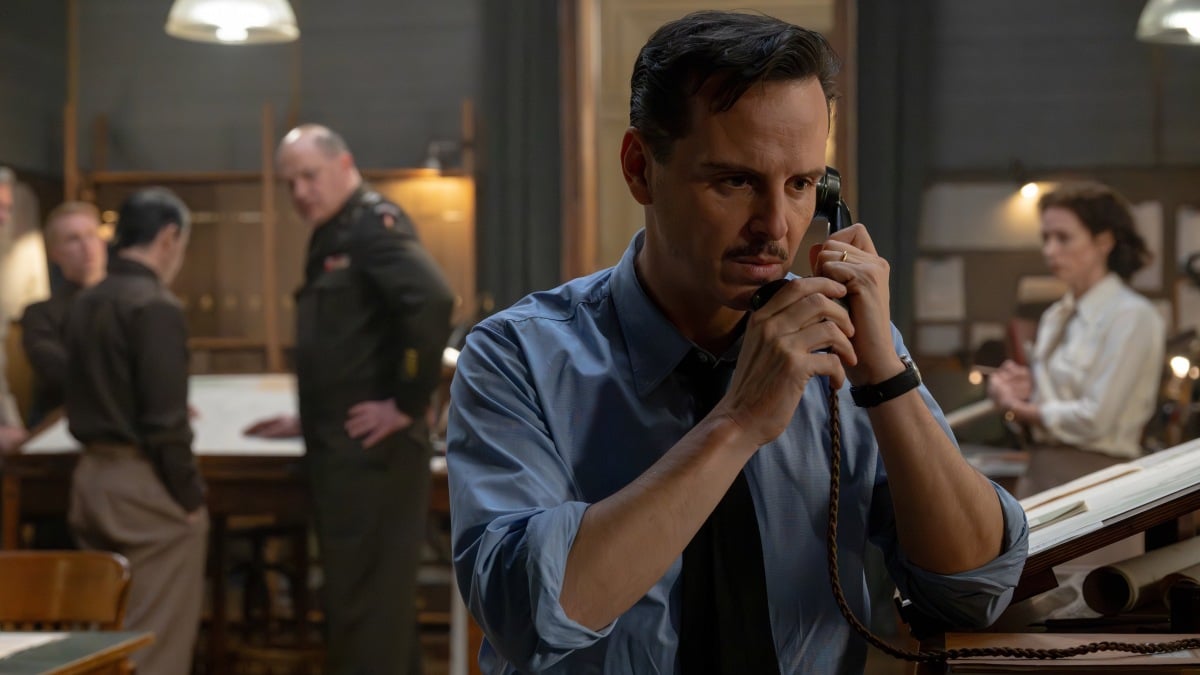
Maras smartly sets Stagg apart from his peers with a hint of color. Cheers to Maras and his cinematographer Jamie D. Ramsay for rejecting the contemporary obsession for desaturated palettes. In Pressure, a rich saturation brings depth to ornate rooms filled with soldiers in brown, khaki, and more brown. Flesh is allowed to flush red in frustration. But most notably, Stagg, in a crisp blue dress shirt, is visually in opposition to the troop of brown around him. Even in a group shot, even with his back turned, this simple choice of embracing color and a simple choice from costumer Liza Bracey, makes him stand out. Perhaps to remind us of how he feels alone in this fight. Or perhaps, stripped down from his dress jacket in moments of high stress, this blue shirt is meant remind us that these icons of history are also just men, as flawed and fearful as they may be revered and brave.
Created with care and great humanity, Pressure explores the hard work, intense co-operation, and tricky social dance of warfare, in a way that is enlightening and entertaining. Maras is respectful without ever falling prey to a stony reverence that would make his characters statues instead of people. Fraser is committed and suitably stern as Eisenhower. Condon balances warmth and clarity as the middleman between Eisenhower and Stagg. Messina is delightfully smarmy. Along with Scott, they create portraits that don’t feel stiff, but are pulsating, precious, and alive.
Pressure is outstanding cinema, propelled by passion, intellect, and spirit. Don’t overlook it.
Pressure opens in theaters May 29.