What a divergence between a 50 million token transfer to an unidentified address, a leverage buildup on Binance, and the worst week of ETF flows in 2026 tells us about where XRP goes next.
Summary
- Ripple transferred 50 million XRP, worth approximately $50.5 million, to an unknown wallet address on August 13, 2026, with 1 million of those tokens subsequently moving to Binance.
- Weekly net inflows into United States spot XRP ETFs collapsed 93 percent, from $14.86 million to just $1.01 million, for the week ending August 8.
- Binance XRP futures open interest reached a 30-day high of 435.1 million tokens on August 12, with the 30-day Z-Score climbing to approximately 1.20.
- Whale wallets are absorbing more than 10 million XRP per day, with large holder outflows from Binance accounting for 91 percent of total exchange outflows.
- The CLARITY Act missed its pre-recess window in the Senate, pushing any legislative clarity on XRPâs commodity status to September at the earliest.
On the evening of August 13, blockchain trackers flagged a transfer that Ripple watchers have learned to treat as a signal rather than noise: 50 million XRP, worth $50.5 million at the time, left a Ripple-linked wallet and landed in an address with no public identity. The receiving wallet had already accumulated 150 million XRP earlier in the month. Within hours, 1 million of those tokens moved again, this time to an address associated with Binance. The remaining 49 million sat still. That same week, the seven United States spot XRP exchange-traded funds recorded their worst inflow figure of the year, while futures traders on the worldâs largest crypto exchange piled into leveraged positions at a pace not seen in a month. Three distinct groups, three conflicting bets. The question is not whether something is happening beneath the surface of XRPâs stagnant price chart. The question is what.
The $50.5 million transfer and what Ripple’s wallet patterns reveal
The wallet that initiated the August 13 transfer, identified on-chain as RL18-VN, is not new to Ripple analysts. It is one of several “extra” wallets the company uses to move XRP outside its corporate treasury, typically routing tokens toward financial institutions, exchanges, and On-Demand Liquidity corridors. The wallet had received 150 million XRP in early August, likely sourced from Rippleâs monthly escrow operations, which release 1 billion XRP on the first of every month before re-escrowing 600 to 800 million of it.
What makes this transfer noteworthy is not the size alone. Ripple moves large quantities of XRP routinely. It is the combination of destination opacity and the subsequent 1 million XRP deposit to Binance. That smaller deposit could represent a liquidity test, a fee payment, or the beginning of a larger distribution. It could also be entirely unrelated to the main transfer. On-chain data does not reveal intent, only movement.
Three plausible explanations have circulated since the transfer was flagged. The first is that Ripple is seeding liquidity for an institutional custody client. The company announced partnerships with DXC Technology, Kyobo Life Insurance, and Thailandâs Kbank in the first half of 2026, all of which involve Ripple Custody infrastructure. A new custody onboarding could require pre-positioned XRP for staking, settlement testing, or wallet provisioning. The second explanation centers on RLUSD expansion. Rippleâs dollar-backed stablecoin now sits at roughly $1.78 billion in market capitalization and spans more than 40 blockchain networks. RLUSD minting on the XRP Ledger requires base layer liquidity, and large XRP movements have historically preceded minting surges. The third, and least popular among Ripple supporters, is simple selling. Ripple has been transparent about using XRP sales to fund operations, and a 50 million token transfer to an intermediary wallet followed by exchange deposits fits that pattern.
None of these explanations can be confirmed from on-chain data alone. The transfer is a Rorschach test for market participants, and what they see in it says more about their positioning than about Rippleâs plans.
The ETF flow drought and what it signals about institutional appetite
The week ending August 8 was supposed to be unremarkable for XRP ETFs. Instead, it became a data point that crystallized a problem the market had been slow to acknowledge: institutional demand for spot XRP exposure is evaporating.
Net inflows across the seven United States spot XRP ETFs fell to $1.01 million, a 93 percent decline from the $14.86 million recorded the prior week. Net assets across the products slipped to $964 million. For context, XRP ETF inflows in April 2026 totaled $81.63 million, and May saw $131.94 million, making it the best inflow month of the year. The collapse happened in the same week that Bitcoin and Ethereum ETFs attracted nine-figure inflows, underscoring that the problem is specific to XRP, not a broad risk-off move.
Several factors contributed to the drought. The Senate set aside the CLARITY Act on July 27 to address other legislative business before its August recess. The bill, which would codify XRPâs digital commodity classification into federal statute and hand oversight to the Commodity Futures Trading Commission, cannot receive a vote until lawmakers return on September 14. Without the legislative backstop, the March 2026 joint SEC-CFTC interpretation classifying XRP as a digital commodity remains an administrative opinion, not law. Institutional allocators, already cautious about a token trading 71 percent below its July 2025 cycle high of $3.65, appear unwilling to increase exposure while the regulatory framework rests on an interpretation that a future administration could reverse.
The ETF flow data also exposes a structural tension in XRPâs market. Ripple landed partnerships with JPMorgan, Deutsche Bank, and SBI in 2026, but these deals primarily involve Rippleâs payments infrastructure and RLUSD instead of XRP as a bridge currency. The company is winning. The token is not capturing the value.
Binance futures open interest and the leverage buildup
While ETF desks went quiet, derivatives traders went the other direction. Binance XRP futures open interest hit 435.1 million tokens on August 12, surpassing its 30-day average and registering a Z-Score of approximately 1.20. Across all exchanges, total open interest reached 2.67 billion XRP in early August, with the Binance buildup representing a 19 percent jump in just over a week.
A rising open interest figure alongside a flat or declining spot price typically means one of two things. Either traders are building long positions in anticipation of a catalyst, or short sellers are piling in to bet on further downside. The funding rate data leans slightly positive, suggesting a marginal long bias, but the signal is not strong enough to draw a definitive conclusion.
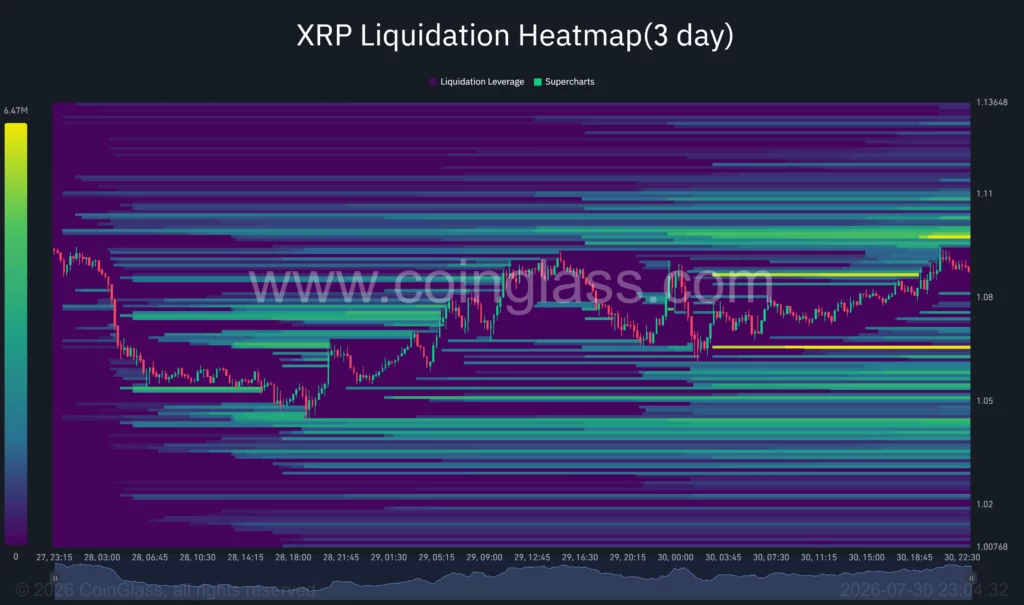
What is clearer is the risk this positioning creates. High open interest on a thin spot book means that a sharp move in either direction will trigger cascading liquidations. If XRP breaks above $1.05, the level that served as support until August 6, short liquidations could accelerate a move toward $1.10 or higher. If it breaks below $1.00, long liquidations could push the price into the $0.90 range that has not been tested since early 2026. The total open interest figure of 2.67 billion XRP across all exchanges represents a notional value exceeding $2.7 billion, more than double the $964 million sitting in ETF products. In other words, the derivatives market is now significantly larger than the regulated spot market for XRP, a structural imbalance that amplifies both the potential reward and the potential damage of any catalyst.
The leverage buildup also reveals a market that is pricing in a binary outcome. Traders are not positioning for drift. They are positioning for resolution, whether that comes from a Ripple announcement, a legislative surprise, or a broader crypto market move that drags XRP along.
Whale accumulation and the retail divergence
The most striking feature of XRPâs August market structure is the gap between what large holders are doing and what everyone else is doing. Whale wallets, defined as addresses holding more than 10 million XRP, are accumulating at the fastest pace since the post-ETF-listing period. On August 11, when XRP tested $1.00, whales absorbed more than 380 million tokens. Large holder outflows from Binance now account for 91 percent of total exchange outflows, the highest concentration since 2024.
Mid-tier whales, wallets holding between 10 million and 100 million XRP, have added roughly 1.23 billion tokens year-to-date, lifting the cohort from about 10.97 billion to 12.2 billion. The accumulation is not speculative day-trading. The tokens are moving off exchanges and into cold storage or custodial wallets, suggesting holders with longer time horizons.
Retail participation, by contrast, has cratered. Google search interest for “XRP” sits near its 2026 low. Social media engagement metrics tracked by Santiment and LunarCrush show declining mention volumes. The three conditions analysts identified for an XRP recovery, sustained ETF inflows, legislative progress, and a return of retail momentum, remain unfulfilled.
This divergence is not unprecedented in crypto markets. Large holders often accumulate during periods of retail apathy, building positions at prices that look unattractive to smaller participants. Bitcoin saw a similar pattern in late 2022, when whale wallets accumulated aggressively at $16,000 to $17,000 while retail volume collapsed. Ethereum experienced a comparable divergence in mid-2023 before its rally above $2,000. Whether the XRP accumulation proves similarly prescient depends entirely on what catalysts materialize in the months ahead, and the historical parallels cut both ways: not every period of whale accumulation precedes a rally, and large holders have been wrong before.
RLUSD’s expanding footprint and the XRP paradox
Rippleâs stablecoin has quietly become one of the most important variables in the XRP equation, though not in the way most XRP holders would prefer. RLUSD surpassed $1 billion in supply on Ethereum alone earlier this year and now sits at approximately $1.78 billion in total market capitalization across more than 40 blockchain networks.
The stablecoinâs growth trajectory is impressive by any measure. Mastercard launched 24/7 settlement capabilities using RLUSD on the XRP Ledger. Aave integrated RLUSD with a $50 million lending pool cap. Abu Dhabiâs Financial Services Regulatory Authority recognized it as an Accepted Fiat-Referenced Token. Ripple introduced Ripple Mint, a unified platform for institutions to access, mint, redeem, and manage the stablecoin. The Bank of New York Mellon serves as primary custodian for RLUSD reserves.
Yet RLUSDâs success creates a paradox for XRP. Rippleâs payment corridors increasingly use fiat and RLUSD rather than XRP as a bridge currency. The companyâs most significant institutional partnerships in 2026, including the JPMorgan tokenized Treasury settlement and the Deutsche Bank integration, route value through Rippleâs infrastructure without requiring XRP as an intermediary. In May, Ripple raised $200 million from Neuberger Berman to expand Ripple Prime, its institutional trading and lending platform. The capital raise valued the companyâs infrastructure independently of XRPâs token price.
This does not mean XRP is irrelevant to Rippleâs ecosystem. The XRP Ledger remains the base layer for a significant portion of RLUSD activity, and XRP serves as gas for transactions on that network. Validator incentives, staking through Ripple Custody partnerships, and potential future protocol changes could increase XRPâs utility. But the current trajectory suggests that Rippleâs corporate success and XRPâs token price have partially decoupled, a reality that most price prediction models struggle to incorporate.
The CLARITY Act and the regulatory vacuum
The CLARITY Actâs failure to reach a Senate floor vote before the August recess removed the single largest near-term catalyst for XRPâs price. The bill would have written XRPâs commodity classification into federal law, replacing the March 2026 joint SEC-CFTC interpretation with something durable. Without it, XRPâs legal status sits in a gray zone: recognized as a digital commodity by the current administrationâs regulators but lacking the statutory protection that would survive a change in leadership.
The Senate filed a cloture motion on August 8 but never advanced the bill to a vote. Polymarketâs prediction contract for the CLARITY Act to be signed into law by the end of 2026 fell to approximately 14 percent. The Senate does not return to legislative business until September 14, and crypto regulation will compete with appropriations, judicial nominations, and other priorities for floor time.
For institutional investors, the regulatory vacuum creates a specific problem. Portfolio mandates at pension funds, endowments, and registered investment advisors often require assets to have clear regulatory classification before allocation limits can be set. The SEC-CFTC interpretation provides some comfort, but it is not the same as a statute. Until the CLARITY Act or equivalent legislation passes, XRP will likely remain underweight in institutional portfolios relative to Bitcoin and Ethereum, both of which have clearer legal standing.
The opposing case: why the mystery transfer may mean nothing
The strongest argument against reading significance into Rippleâs $50.5 million transfer is that Ripple moves far larger sums routinely. In a single week in July, the company moved 300 million XRP, worth $652 million, through similar wallet patterns. The RL18-VN wallet is a known operational address, not a new or unusual destination. The 1 million XRP deposit to Binance represents 2 percent of the total transfer and could be a routine exchange deposit for any number of operational purposes.
The ETF flow collapse, while dramatic in percentage terms, represents a shift from a small number to a smaller number. Weekly inflows of $14.86 million were already modest by the standards of the Bitcoin and Ethereum ETF markets. The 93 percent decline is mathematically striking but may simply reflect a quiet week instead of a structural shift.
The futures open interest buildup could unwind without a dramatic price move. Open interest rises and falls with market maker positioning, hedging activity, and basis trades that have nothing to do with directional conviction. A 30-day high is notable but not historically extreme.
What would invalidate the thesis that Ripple is preparing for a significant liquidity event? If the 49 million XRP in the unknown wallet move back to a Ripple treasury address or are re-escrowed, that would suggest the transfer was routine treasury management. If whale accumulation reverses and large holders begin depositing to exchanges, the “smart money” narrative collapses. If the CLARITY Act fails entirely and Rippleâs institutional partners proceed without requiring XRP exposure, the tokenâs structural demand problem would worsen regardless of any single wallet transfer.
What to watch
The next 72 hours will clarify whether the remaining 49 million XRP move to an exchange, to an institutional counterparty, or stay dormant. Tracker alerts from Whale Alert and XRPL Monitor will provide real-time updates.
Weekly ETF flow data, published each Friday by ETF providers, will show whether the August 8 collapse was an anomaly or the beginning of a sustained withdrawal of institutional interest. Two consecutive weeks below $5 million would mark the weakest stretch since the ETFs launched.
Binance open interest data, available in real time through Coinalyze and CoinGlass, will indicate whether the leverage buildup resolves through liquidation or orderly position closing. A sudden drop in open interest paired with a price spike in either direction would signal forced liquidation.
RLUSD minting activity on the XRP Ledger, trackable through XRPL explorers, could confirm or deny the hypothesis that the XRP transfer is linked to stablecoin operations. A minting surge within days of the transfer would be the strongest circumstantial evidence connecting the two events.
The Senateâs September 14 return date is fixed. Any indication from Senate leadership about the CLARITY Actâs priority ranking in the fall calendar will move prediction markets and, by extension, XRPâs price.
Why did Ripple move 50 million XRP to an unknown wallet?
Ripple has not disclosed the purpose of the August 13 transfer. On-chain analysis shows the receiving wallet, linked to Ripple’s RL18-VN operational address, has been used previously to route XRP to financial institutions, exchanges, and On-Demand Liquidity corridors. The 1 million XRP subsequently sent to Binance suggests at least partial exchange-related activity, but the remaining 49 million tokens have not moved as of August 14.
How much did XRP ETF inflows drop in August 2026?
Weekly net inflows into the seven United States spot XRP ETFs fell 93 percent, from $14.86 million to $1.01 million, for the week ending August 8, 2026. Net assets across all XRP ETF products declined to $964 million. This marked the weakest weekly inflow figure since the ETFs launched in late 2025.
What is XRP’s price as of August 14, 2026?
XRP traded between $0.99 and $1.03 on August 14, 2026, hovering near the psychologically significant $1.00 level. The token is approximately 71 percent below its cycle high of $3.65, set on July 17, 2025, and has traded in a narrowing range since early August.
What is the CLARITY Act and why does it matter for XRP?
The CLARITY Act is proposed federal legislation that would codify XRP’s classification as a digital commodity into United States law and assign oversight to the Commodity Futures Trading Commission. Currently, XRP’s commodity status rests on a March 2026 joint SEC-CFTC interpretation, which is an administrative opinion rather than a statute. The Senate set the bill aside before its August recess and does not return until September 14.
Why is Binance XRP futures open interest rising while the spot price is flat?
Binance XRP futures open interest reached 435.1 million tokens on August 12, a 30-day high, despite XRP’s spot price remaining range-bound near $1.00. This pattern typically indicates that traders are positioning for a large directional move instead of trading current momentum. The slightly positive funding rate suggests a marginal long bias, but the buildup could also reflect hedging activity or basis trades.
What is RLUSD and how does it affect XRP?
RLUSD is Ripple’s dollar-backed stablecoin, currently at approximately $1.78 billion in market capitalization across more than 40 blockchain networks. While RLUSD’s growth validates Ripple’s infrastructure, it creates a paradox for XRP because Ripple’s payment corridors increasingly use RLUSD instead of XRP as a bridge currency. The XRP Ledger remains RLUSD’s base layer, but the token’s role as a transactional intermediary has diminished.
Are whales accumulating or selling XRP in August 2026?
Whales are accumulating. Large holder outflows from Binance account for 91 percent of total exchange outflows, the highest concentration since 2024. Wallets holding between 10 million and 100 million XRP have added roughly 1.23 billion tokens year-to-date. On August 11, whales absorbed more than 380 million XRP during the test of the $1.00 level.
What would invalidate the thesis that Ripple is preparing a major liquidity event?
If the 49 million XRP remaining in the unknown wallet return to a Ripple treasury address or are re-escrowed, the transfer was likely routine treasury management. If whale accumulation reverses and large holders begin depositing to exchanges, the “smart money” narrative would collapse. If the CLARITY Act fails entirely and Ripple’s institutional partners proceed without requiring XRP exposure, the token’s demand outlook would weaken regardless of any single transfer. This is educational analysis, not investment advice.
Disclosure: This article is for informational purposes only and does not constitute financial, investment, or legal advice. Cryptocurrency investments carry significant risk, including the potential loss of all capital. The author and crypto.news do not hold positions in XRP, RLUSD, or any Ripple-affiliated products mentioned in this article. Always conduct your own research before making investment decisions. Published August 14, 2026.