
Key Takeaways
- David Walsh, Marius Smith and Matthew Dawson launched Ethereum Institutional in 2026.
- The nonprofit gives banks and asset managers free access to Ethereum guidance.
- Ethlabs and the Enterprise Ethereum Alliance now work alongside the new group.
Ethereum Institutional debuted in 2026 as an independent organization dedicated to institutional adoption of Ethereum, its layer-2 networks, and its broader application stack. The group was incubated at the Ethereum Foundation before spinning out as its own entity.
Three Founders, One Mission
David Walsh leads the effort after building the Ethereum Foundation’s original enterprise function, where he spent five years engaging hundreds of institutions. He previously worked at EY Financial Services.
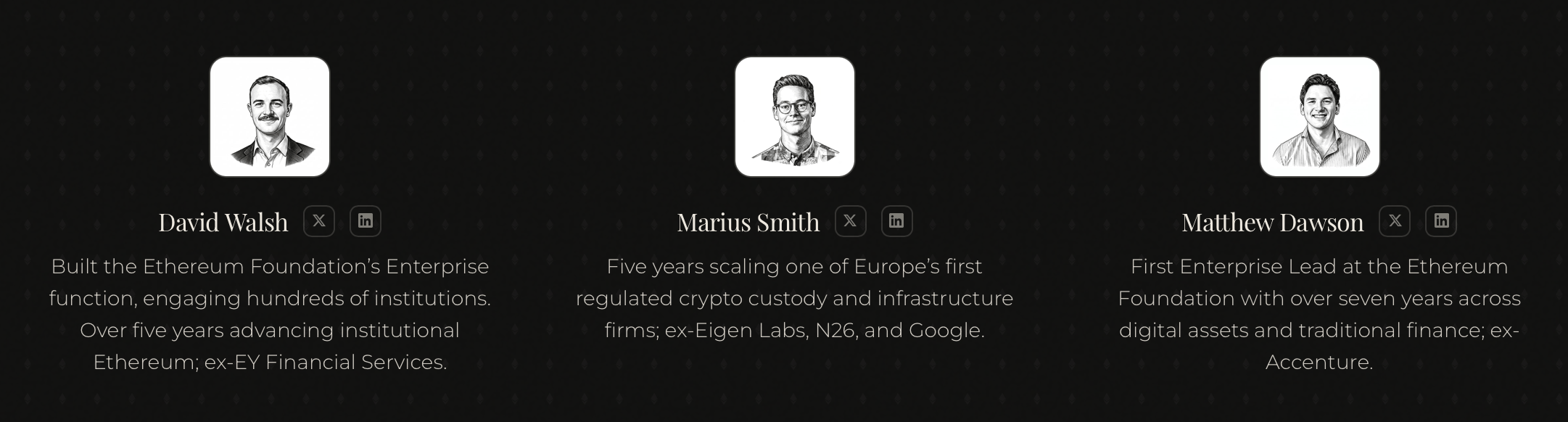
Marius Smith joins after five years scaling one of Europe’s first regulated crypto custody and infrastructure firms. His background includes stints at Eigen Labs, N26 and Google.
Matthew Dawson served as the Ethereum Foundation’s first Enterprise Lead, spending seven years across digital assets and traditional finance. He previously worked at Accenture.
The team says it is hiring and has posted a contact address, [email protected], for prospective hires.
Why Institutions Need a Counterparty
Banks do not adopt blockchain infrastructure by reading a technical paper. Large institutions run multi-stakeholder reviews that pull in legal teams, regulators, and executive committees. Those reviews need a person to call.
Ethereum Institutional positions itself as that person. The nonprofit points to decision complexity as its core problem to solve. Institutions now face a choice among layer-1 networks, layer-2 rollups, app-chains, custody providers, and compliance vendors. Without a neutral guide, that complexity tends to push institutions toward fragmented, less liquid solutions.
A Different Role Than the Ethereum Foundation
The Ethereum Foundation made a decision this year to narrow its focus to protocol research and development. That left an opening for institutional engagement work, which Ethereum Institutional now fills.
The nonprofit also draws a line between itself and Ethlabs, another Ethereum-aligned organization. Ethereum Institutional describes its own role as generating institutional demand and translating Ethereum’s value proposition into terms banks understand. Ethlabs, by contrast, focuses on turning that demand into shipped technical products.
Ethereum Institutional says it works alongside Ethlabs, Etherealize, and the Enterprise Ethereum Alliance, citing prior relationships the founding team built while at the Ethereum Foundation.
No Fees, Nonprofit Structure
Ethereum Institutional disclosed that it does not charge advisory or consulting fees. Engagement with the group is free. The founders chose a nonprofit structure specifically to avoid commercial incentives that could favor one vendor or product over another. That structure, the group says, is what allows it to act as a credible, neutral party for banks evaluating Ethereum.
What This Means for Traders
A dedicated institutional front door lowers friction for banks entering Ethereum. Faster, better-coordinated institutional onboarding tends to support deeper liquidity and steadier demand for ETH and Ethereum-based assets over time.